What are the common characteristics of growing churches?

A recent report on church growth and decline could prove to be a treasure trove for leaders seeking both facts and ideas.

Kirk Hadaway, chief statistician and researcher with the Episcopal Church, compiles dozens of contributing factors in the piece, and Victoria Heard, head of church planting and congregational development for the Diocese of Dallas, has

done an excellent job crystallizing his work down to what she considers the essentials. Heard assumes first a “robust proclamation” of the Nicene Creed,  and then presents a six-pack of fundamentals. 

1. A kingdom road map

2. The children go up front

3. Sunday school still works

4. A culture of learning for adults

5. Hospitality that counts

6. Add a service, stir up the sound

You can link to her excellent and challenging full article here.

The power and lasting effect of Operation Christmas Child shoeboxes

Operation Christmas Child honestly does bring hope and joy to children in desperate situations around the world through gift-filled shoe boxes as well as the Good News of God's love. It's such a simple way to be part of a hands-on missions project while focusing on the true meaning of Christmas—Jesus Christ.

If you have the slightest doubt that such a small gift helps or has much if any effect on a child receiving one, please take a few minutes to watch Damaris’ story:


As Damaris explains, you cannot impact one child without impacting her or his family and wider community: the proverbial gift that keeps on giving.

Boxes from Eastern Ontario go to children in Africa, Central America, South America, needy Caribbean countries, and the Ukraine.

You can find more information on Samaritan’s Purse and its Operation Christmas Child here.

A divinely-orchestrated day for the Archbishop to visit

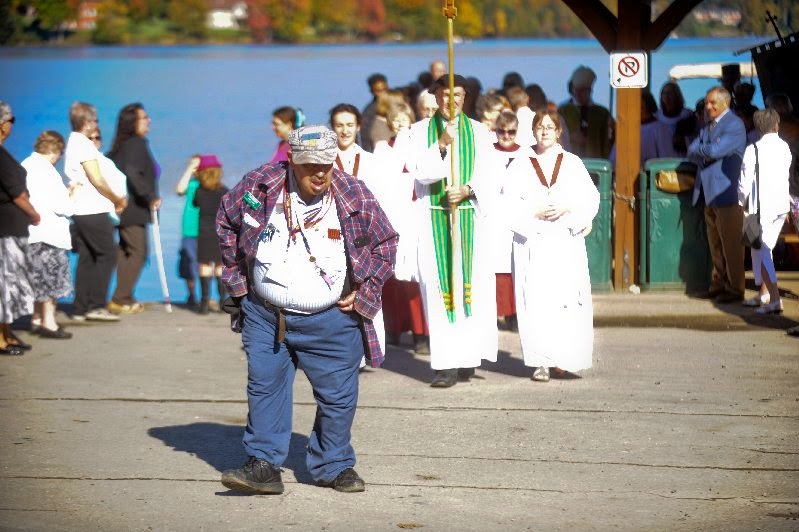
On a perfectly beautiful recent fall Sunday, St. George’s choir and congregation gathered at the Haliburton docks to greet Archbishop Colin Johnson. They sang out a special 150th anniversary song written by organist-extraordinaire, Bill Gliddon, as the bishop arrived by boat.

Accomplished actor and St. George’s member Curtis Eastmure—playing the role of Charles Stewart—spoke eloquently, welcoming the bishop. Stewart had been a manager for the Canadian Land Emigration Company who, after first spying the land from the lake, later oversaw the building of the small wooden 16-by-24-foot building which would become the first church.

After the speech, choir, clergy, parishioners and visitors filed across the street and up the scenic stairs to St. George's for the anniversary service. The choir sang out Te Deum Laudamus (We praise you O God)—an anthem also written by Bill Gliddon.

Colin Johnson’s sermon on ecumenism fit and sat well with the attendants and atmosphere. Members of the various Haliburton churches came forward as the service wrapped up, with greetings and congratulations from their congregations.

“What a marvellous time we had!” reported rector Anne Moore in her Thanksgiving letter. “The weather was perfect; the colours at their prime; the food tasty; the choir and Highland Brass in splendid form; and good friends gathered to celebrate our history and our future. Thanks to the anniversary committee for a well-planned and very enjoyable day. Thank You, Lord, for Your mercy is everlasting.

“Giving thanks is good for the soul. It gets our minds off ourselves and our personal worries and onto the One who created each one of us, on purpose, and Who loves us constantly and unconditionally. Praise You, Lord. May we all have thankful hearts.”

(Photos by Darren Lum)

How to pray when you don’t know how

A good question, no? How can one possibly pray if you don’t know how to pray?

A traditional Chasidic story speaks glowingly of the prayer of an uneducated Jew who wanted to pray, did not speak Hebrew, but thought Hebrew a necessity for prayers to be heard by God. So he began to recite the only Hebrew he knew: the alphabet. He recited it over and over again, until a rabbi asked what he was doing. The man told the rabbi, "The Holy One, Blessed is He, knows what is in my heart. I will give Him the letters, and He can put the words together."

A Prayer for Every Need, a book by old faithful Norman Vincent Peale, provides wording for prayers for many situations. If you’re one who finds a formula or model helpful, you can download a free copy of that book here.

Charismatics would answer that you pray in your ‘prayer language’, the mysterious gift of praying in tongues many of us have heard of or experienced.

Charisma magazine published an interesting article exploring many aspects of this, Tongues: Is It the Initial Sign of the Holy Spirit's Filling? by John Sherrill.

Personally, I’ve found ‘HELP!’ and ‘Thank-You’ two of the easiest and best.