
The Very Model of a Modern Trinitarian
/Don’t miss Fr. Ken McClure’s hilariously brilliant Trinitarian take on Gilbert and Sullivan’s famous ‘patter song’, I Am the Very Model of a Modern Major-General!

INTERIM PRIEST-IN-CHARGE
The Reverend Canon Dr. David Barker
Holy Eucharist: 10:30 a.m. each Sunday @ St. George’s
All welcome to stay for refreshments and fellowship afterwards!
Watch each Sunday service as it happens via the livestream below, or later at your convenience. You can also find all previous services, as well as the Reverend Canon Dr. David Barker’s readings for each Sunday, on the church YouTube channel (HALIBURTON ANGLICAN @haliburtonanglican).
[Visiting on a smartphone? Find the dropdown menu (‘ABOUT’, ‘MINISTRIES’, ‘MUSIC’ etc.) by clicking on the 3 lines to the left of our name at the top of the page]
Don’t miss Fr. Ken McClure’s hilariously brilliant Trinitarian take on Gilbert and Sullivan’s famous ‘patter song’, I Am the Very Model of a Modern Major-General!
A single guy decided life would be more fun if he had a pet. So he went to the pet store and told the owner that he wanted to buy an unusual pet. After some discussion, he finally bought a talking centipede, which came in a little white box to use for his house.
He took the box back home, found a good spot for it, and decided he would start off by taking his new pet to church with him. So he turned to the centipede in the box.
"Would you like to go to church with me today? We will have a good time." But there was no answer from his new pet. This bothered him a bit, so he waited a few minutes and decided to try again.
"How about going to church with me and receive blessings?"
Again, no answer from his new friend and pet. So he waited a few minutes more, pondering the situation. He decided to invite the centipede one last time. He put his face smack up against the centipede's house.
"Hey, in there!” he yelled. “Would you like to go to church with me and learn about God?!?"
This time, a little voice hollered from the box.
"I HEARD YOU THE FIRST TIME! I'M PUTTING MY SHOES ON!"

(Based on a recent Anglican Journal article)
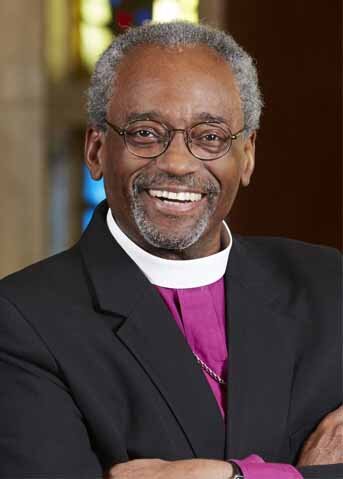
“The church has always—Christians, I’m not using ‘church’ as an institution, necessarily—the church has always been strongest the closer it has been to Jesus of Nazareth and his actual teachings and his spirit,” said Bishop Michael Curry recently in an interview with Joelle Kidd of the Anglican Journal. “It has tended to be weakest, frankly, the more aligned it is with the status quo in the actual society.”
The 27th and current presiding bishop of the U.S.-based Episcopal Church, Bishop Curry came to international attention last year when he preached at the wedding of Prince Harry and Meghan Markle. In a wide-ranging discussion with the Journal while attending the meeting of General Synod in Vancouver, he spoke about the health of the church, cross-border church relationships and his post-royal wedding fame.
“If we are about preserving ourselves as an institution, and our institutional structures, then we are at the mercy of the cultural forces around us,” the engaging, animated bishop shared. “If we are about following the risen Christ, this Jesus of Nazareth, and making our witness in the world, then we will figure out how to navigate with maybe less money or fewer people. We will figure out how to navigate if we have more money and more people. That won’t matter. What will matter is the closer we are to this Jesus of Nazareth, and following his actual teachings—not just the idea of it, but his real teachings.”
“ … when our consciousness of being Christian is dependent on our institutional forms, then we’ve missed the point,” he went on. “We’ve substituted the outward form for the inward reality—and it’s the inward reality that endured.

Episcopal Church Presiding Bishop Michael Curry speaks at the church's 79th General Convention in 2018. Photo: Asher Imtiaz /The Living Church
“There’s a collect that prays that we ‘hold fast to things eternal, even as we pass through things temporary.’ That is what we must do.”
And what about his new-found notoriety? Do more people notice and approach him now?
“That does happen,” he admitted. “The nice thing is, it has opened up conversations with people—conversations about real stuff.”
You can read the interview, edited for length, at the Anglican Journal site here.
[Aug. 11] A standing ovation for beloved about-to-be 80 years young Bill Gliddon concluded a joint St. George’s/St. Margaret’s Sunday service to honour not only Bill’s 57 years as choir director, but his role as a pillar of the community. The congregation then adjourned to the outdoors for the birthday celebrations, joined by many others he has touched over the years in thousands of ways.
![Bill with one of the young Wisos [image thanks to the Highlander]](https://images.squarespace-cdn.com/content/v1/56aa795da2bab84175c06910/1566264425239-YHC3QAGR8VOKNAHR4OHC/Bill-Gliddon+highlander+pic2+lr.jpg)
Bill with one of the young Wisos [image thanks to the Highlander]
Born and raised in Haliburton, Bill left briefly to study music, then returned to teach music locally. He continues to live in the very house he grew up in.
When the Anglican church needed a church organist, he took on the job—even though he has, he says, never taken an organ lesson in his life!
To quote from the Highlander’s article on the celebration:
Through his work with the church, Gliddon has forged hundreds of connections with people. Rev. Ken McClure said Gliddon is a pillar of the church.

Bill w Wendy Vermeersch
“If there’s somebody who’s sick, he knows about it, he visits in a heartbeat. If there’s somebody that needs to drive somewhere, Bill’s going to do it,” McClure said. “He is an example of what every one of us should be doing and being in church.”
Gliddon also practices that altruism at home. He keeps a cooler at the front of his driveway, stocked with water bottles for people passing by.

Ever-engaging Bill
“If you really follow the Christian example, you don’t think of yourself as much as you think of other people,” Gliddon said. “If you’re helping other people, it makes you happy because you’re making them happy. I think that’s the way. If the world was like that, it would be great.”
He said the event was not about him, but the whole community.
“This is what life is all about is being a family. And we are a wonderful family in this community,” Gliddon said. “We are so blessed to live in this beautiful spot.”
[inspired by a recent talk by Fr. Ken]

Barnabas may be the apostle we hear the least about, but without him, the early spread of Christianity would most certainly have been severely curtailed.
Born Joseph of Jewish parents in Cyprus, we’re given the earliest big example of why the apostles nicknamed him Barnabas—an Aramaic expression meaning ‘son of encouragement’ in Acts 4. There we learn that soon after his conversion, he “sold a field that belonged to him, then brought the money and laid it at the apostles’ feet” (Acts 4:36-37). For the likely hand-to-mouth disciples, this would have been a big deal.
Perhaps most significantly, when Christian-killing Saul—after his Damascus road experience—attempted to join up with the disciples in Jerusalem, Barnabas courageously vouched for him. Some early sources say Joseph and Saul, soon to be Barnabas and Paul, had known each other through having been fellow students of the renowned Jewish teacher Gamaliel. Who knows how long the Jerusalem church, understandably suspicious of their former persecutor, would have otherwise taken to accept the man who would become foremost in the early spread of the Gospel (Acts 9:26-31)?
A short time later, when the leaders of the church in Jerusalem became concerned at the news that even Gentiles were accepting Christ as their saviour in the northern city of Antioch, they sent Barnabas to investigate. It seems that since he had gotten it so right with Paul, they trusted his judgement. His visit there being so illustrative of who he was and how important to the growth of the church, it’s worth quoting the whole story from Acts.
“When he came and saw the grace of God, he rejoiced, and he exhorted them all to remain faithful to the Lord with steadfast devotion; for he was a good man, full of the Holy Spirit and of faith. And a great many people were brought to the Lord. Then Barnabas went to Tarsus to look for Saul, and when he had found him, he brought him to Antioch. So it was that for an entire year they met with the church and taught a great many people, and it was in Antioch that the disciples were first called ‘Christians’. "
—Acts 11: 23-26
Barnabas then, along with Paul, helped to smooth out Jew/Gentile tensions that arose in the early church and both took part in the Council of Jerusalem, called to specifically address these issues.
Like everyone who works together, whether in ministry or not, disagreements arose. Yet Barnabas seemed to always, with God’s help, manage to turn the situations around.
At one point he and Paul disagree over the propriety of taking Mark along on a missionary journey, stalwart Paul being against it because Mark had abandoned them on a previous trip. Barnabas the bridge-builder preferred to give him another chance. Unbending Paul refused, selecting Silas as his new mission partner.
Humanly speaking the unresolved contention seemed to cause an unfortunate split in the early church. Yet like cells dividing in an organism to build a body, God used that very split to create two missions out of one and accelerate the growth of His church. Barnabas headed out with Mark to Cyprus, and Paul brought in Silas to help with his own missions through Syria and Cilicia. As Ken suggested, we might not even have the Gospel of Mark were it not for the conciliatory efforts of St. Barnabas.
While all are not called out on far-ranging mission trips or to be leaders, surely, in our broken world, we need to answer the call to be encouragers, bridge-builders and peace-promoters.
Best church in Haliburton, Ontario
.